
When a fence starts leaning, rattling or showing signs of rot, the first decision is whether a repair will sort it or whether the whole run needs replacing. Get this right and you avoid paying for a full replacement you didn't need — or throwing good money at a fence that will fail again next winter. This guide explains how we assess a fence on site and recommend one option over the other.
When repairing a leaning fence makes sense
A leaning fence usually points to movement in the ground or a post that has worked loose. If the post itself is still sound at ground level, it can often be re-set and re-concreted without replacing it. This is a straightforward, cost-effective repair that keeps the existing panels and posts in place.
Repairing a leaning fence is worth it when the rest of the run — the panels, rails and the other posts — is in good condition. One loose post does not mean the whole fence is failing.
When concrete repair spurs are appropriate
A concrete repair spur is bolted to the lower part of an existing timber post and set into concrete in the ground. It braces the post without digging it out, which makes it ideal when a post has worked loose but has not rotted through.
In Headington, we repaired a fence where two timber posts had failed at ground level but the panels were still sound. We straightened the fence and secured the posts with concrete repair spurs. The work took around two hours and the homeowner kept their existing panels — a fraction of the cost of a full replacement.
We have carried out similar concrete spur repairs in Witney, again retaining the existing panels and bracing the posts rather than replacing them.
When a broken panel can be replaced individually
If a panel has been damaged by wind, impact or rot but the posts and rails on either side are still sound, a single replacement panel can be fitted without disturbing the rest of the run. This is the least expensive type of repair and is worth doing whenever the surrounding structure is solid.
See our fence panel replacement service for more on how this works.
Signs that timber posts or rails are beyond repair
Not every post can be saved. The clearest signs that a post or rail is beyond repair are:
- Timber that crumbles or flakes when probed at ground level — a sign of advanced rot.
- A post that has rotted through completely and no longer has a solid base to brace.
- Rails that are soft, split or bowing under the weight of the boards.
- Multiple posts along the run showing the same decay.
When a post has rotted through, a repair spur will not hold it securely and the post needs replacing.
When widespread rot makes full replacement more economical
If rot or movement is widespread — several posts, a long run of failing rails, or panels that are all reaching the end of their life — a full replacement is usually better value. The labour of repeatedly patching a failing fence soon adds up, and a new fence built with pressure-treated timber and concreted posts will outlast a series of repairs.
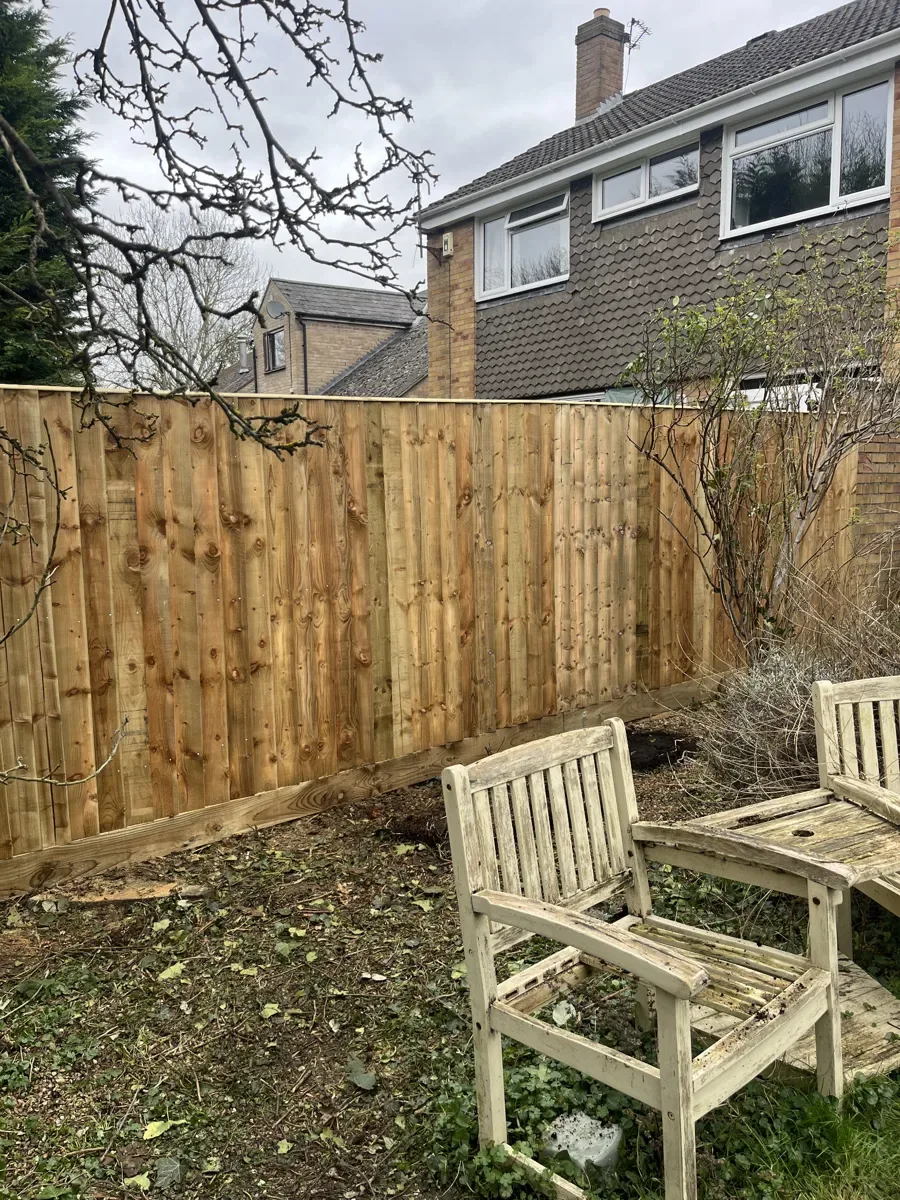
On a fence replacement in Abingdon, the existing painted fence had become rotten and wobbly across the whole run. Repairing it post by post would have cost nearly as much as a replacement and left the homeowner with a fence still nearing the end of its life. A full replacement with site-built featheredge fencing was the practical choice.
How age, structural condition and future maintenance affect the decision
The right choice depends on more than the cost of today's repair. An older fence that has given fifteen or twenty years of service is likely to need further repairs soon, even if this one is fixed. A newer fence with isolated damage is usually worth repairing. Think about how long you plan to stay in the property and how much ongoing maintenance you want to take on.
The advantages and limitations of both options
Repair
Advantages: lower cost, less disruption, retains existing panels and posts, faster to complete.
Limitations: only suitable when the rest of the run is sound; a repaired fence may still be nearing the end of its life.
Replacement
Advantages: a fresh start with new treated timber and concreted posts; longer lifespan; consistent appearance along the whole run.
Limitations: higher upfront cost; more disruption during installation.
How Creative Scapes assesses a fence before quoting
Before recommending a repair or a replacement, we look at the whole run on site. We check each post at ground level for rot, test the rails and fixings, and assess how many sections are genuinely sound. We then set out both options honestly — what can be repaired, what would need replacing, and the cost of each — so you can decide.
For a detailed breakdown of repair pricing, read our fence repair cost guide. To arrange a free site visit and assessment, request a fence repair quote.